Pancakes and PCBs: I Reflowed Real Boards on a $12 Hot Plate So You Don't Have To
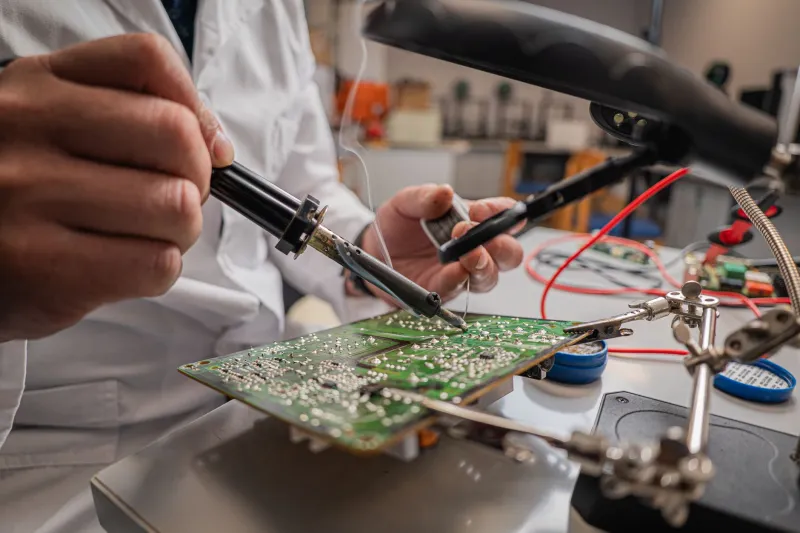
There's a moment in every hardware hobbyist's life when hand-soldering a 32-pin QFN with an iron starts feeling like performing surgery with a fork. That's usually when the YouTube algorithm starts feeding you reflow hot plate videos, and you discover that for the price of two lattes, you can supposedly melt solder paste across an entire board like some kind of electronics wizard.
But does a $12 hot plate from an overseas marketplace actually work? Or is it just a fire hazard with a USB cable? I bought one, along with a mid-range unit that costs about eight times more, and spent three weeks reflowing real projects on both.
The Contenders
The cheap unit is a completely unbranded 300x200mm aluminum plate with a single knob, a red LED, and a power cord that looks like it was attached as an afterthought. The mid-range option — in the $90-100 range, think the kind of unit Makerspaces keep on the bench — adds a digital temperature readout, adjustable presets, and a preheat/soak/reflow profile you can actually program.
Both claim to hit 300°C. Neither comes with any documentation worth the name.
Test One: The ESP32 Breakout Board
First up, a straightforward ESP32-WROOM module board with mostly 0805 passives and a couple of SOIC chips. This is the kind of board most makers will actually build first, so it's a fair baseline.
With leaded paste (yes, I know, ventilate your workspace), the cheap plate took about four minutes to bring the board up to reflow temperature. The problem isn't whether it gets hot — it's that it gets hot unevenly. Probing the plate surface with a thermocouple showed nearly a 25°C difference between the center and the edges. Boards reflowed near the center came out fine; boards hung halfway off the plate had dull, cold joints on one side of the module.
The mid-range unit, by contrast, held a center-to-edge spread of about 6°C and followed a textbook profile: slow ramp, a soak around 150°C, then a quick climb past the paste's liquidus. The joints came out shiny and consistent every single time.
Test Two: 0402 Components and the Humility Test
If you want to find out what your reflow setup is really made of, put some 0402 resistors on it. These tiny parts have almost zero thermal mass, which means they're the first to suffer from sloppy temperature control.
On the cheap plate, I got roughly a 70% success rate on 0402 parts across five boards. The failures were the classic reflow horror show: tombstoning, where a component stands up on one end like a tiny gravestone, and solder beads wandering off to parts unknown. Every failure traced back to the same root cause — the plate's wild temperature overshoot. It blew past 250°C by a good margin before the thermal mass of the aluminum caught up.
The mid-range plate nailed it. Tombstoning happened exactly once in five boards, and that was on a pad I'd designed asymmetrically. That's a me problem, not a machine problem.
The Failure Modes Nobody Mentions in the Product Listings
A few things I learned the hard way:
The cheap plate's thermostat is a suggestion, not a control system. Mine cycled between 210°C and 285°C hunting for a target it never quite held. You can work around this with a separate plug-in temperature controller, but now you've spent more money and built a Rube Goldberg machine.
Kapton tape is not always your friend. On both plates, tape under the board created an insulating layer that dropped the board's actual temperature by 15-20°C. Clamp or weight the board instead.
Smoke happens. Both plates smoked on their first few runs as flux and manufacturing residue burned off. Do your first runs outside or under serious ventilation, and definitely don't run these on a carpeted floor like some brave fool on a certain video platform.
So Is the Upgrade Worth It?
Here's my honest take. If you're assembling your first custom boards — mostly 0805 parts, SOIC chips, and castellated modules — the $12 plate will get you there. It's slow, it's inconsistent, and you'll rework a few joints with an iron, but it works. For the price of a pizza, it's a genuinely transformative tool.
But if you're designing boards with fine-pitch parts, 0402s, or anything where a rework loop costs you an hour, the mid-range unit pays for itself in avoided frustration almost immediately. The difference isn't subtle. Consistent profiles mean fewer dead boards, fewer mystery failures, and — the underrated part — more confidence to actually hit that 'order' button on your next PCB batch.
And that's the real answer to the question. The best hot plate is the one that removes your excuses for designing the board in the first place. Mine arrived on a Tuesday; by Friday I'd sent two new designs off to fab. If a $12 kitchen-looking gadget does that for you, it's already earned its keep.